Our reproductive lives are considerably different from those of our ancestors, thanks in part to health innovations that have taken place over the past few decades. Practices such as IVF, donor eggs and sperm, womb transplants, surrogacy and egg freezing, mean that for many, there’s now more choice than ever before over whether, when and how to reproduce. Yet, despite these advances, one aspect of reproduction has remained constant: the need to gestate (grow) foetuses in the womb.
Recently, the idea of Ectogenesis – growing a foetus outside the body – has been science fiction.
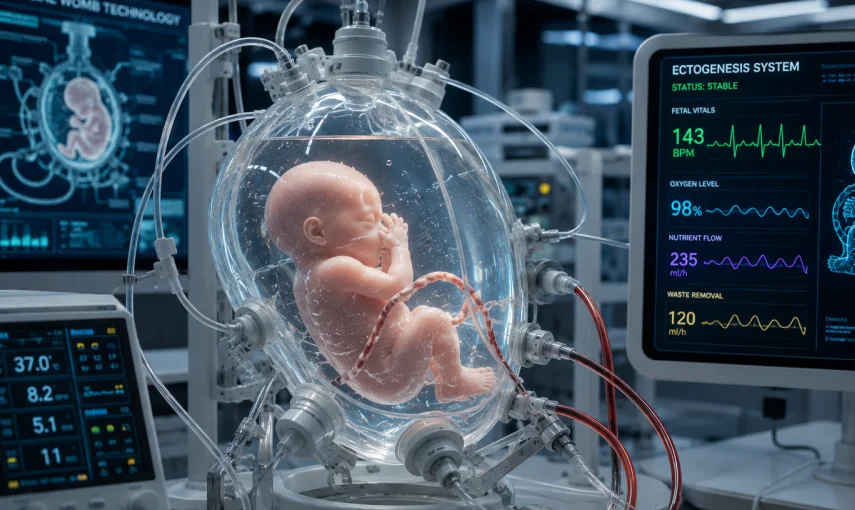
Ectogenesis of human embryos and fetuses would require an artificial uterus. An artificial uterus would have to be supplied with nutrients and oxygen from some source to nurture the fetus, as well as dispose of waste material.
What is Ectogenesis?
The term ‘ectogenesis’ describes the complete or partial gestation of a fetus outside of the human body. It is also referred to as ‘ectogestation’, ‘extra-corporeal gestation’ and ‘artificial womb technology’.
Types:
- Complete: Complete ectogenesis is when the entire process of conception, embryonic development, and gestation takes place outside the human body.
- Partial: Partial ectogenesis is most often used to describe the transfer of a partially developed fetus from the human womb to an artificial womb to complete gestation.
Who can get benefited:
- Homosexual , impotent, disabled and single men
- Alternative to surrogate pregnancy and a sperm donar
- Choice for multiple pregnant mothers
- Mothers with placental insufficiency
- Extremely preterm babies
- Ovulation irregularities
- Blocked fallopian tubes
- Structural abnormalities
- Age or underlying medical problems
- Alternative to the NICU
First Trial of Ectogenesis: It was done In 1997- a 17 week old goat fetus was removed from its mothers uterus, and survived for three weeks in an artificial womb..
What are the challenges Researchers facing:
- The 14-day rule, also known as the 14-day limit
- According to current legislation worldwide .It stipulates that human embryos, for whatever purpose, should not be grown in vitro for longer than 14 days after the point of fertilization.
- Canada, China, India, Japan, Spain and the United Kingdom — permit limited human embryo research up to (and not beyond) 14 days.
- Austria, Germany, Italy, Russia and Turkey — do not permit research involving human embryos.
- Some countries permit such research without stipulating any kind of time limit, for example, Brazil and France.
How about Human’s:
The prospect of ectogenesis for humans does not seem far away Scientists says it could be.
This technology used in the extend system has been tested on lamb fetuses about 300 so far with good results.
To move forward with human testing requires safety, technical and ethical issues to be resolved.
Although artificial wombs are not yet approved for human use, ongoing research and discussions suggest that they could significantly improve outcomes for preterm infants.
Ectogenesis is a new concept and new health technology that is yet to be fully explored