
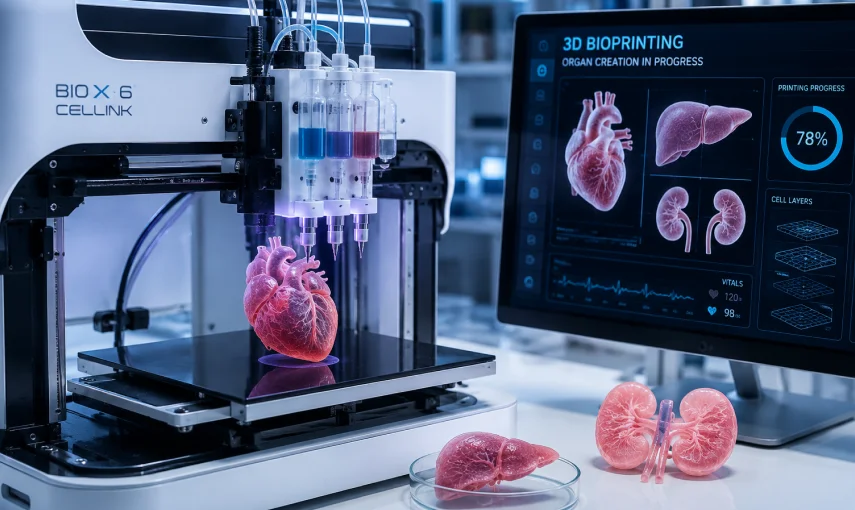
SETTING THE STAGE
Imagine a world where organ shortages are a thing of the past – a world of custom-made organs. This isn’t a page from a Sci-Fi novel, rather, 3D bio-printing an innovative new technology, poised to transform healthcare. Combining recent advances in engineering and biology with material science’s cutting-edge technology, 3D bio-printing is poised to help unlock an era of regenerative medicine, and the ability to grow fully functional human organs.
EVOLUTION
Bio-printing’s roots were established in the early 1984 with Charles Hull’s stereo-lithography, which enabled 3D printing. Subsequently, in 1988 Klebe advanced cell printing through ink-jet methods. By 2003, Dr. Atala’s team achieved a significant milestone by successfully printing living cells onto scaffolds. In 2019, Tel Aviv University bio-printed a small heart complete with blood vessels, demonstrating the potential for complex organs. These achievements propel bio-printing’s possibilities toward clinical application.
BIOINKS AT WORK
Bioprinting utilizes “bioinks,” which are hydrogels containing cells, such as stem cells, to create organ-like tissues. Precision printers, employing extrusion or laser techniques, place bioinks according to models derived from CT/MRI scans.
Techniques like FRESH facilitate scaffold-free printing of soft tissues. Bioprinted skin and cartilage are approaching clinical application, with skin grafts poised to transform burn treatment.(FIG 1)
FIG-1
- Vascular structures fabrication using agarose as sacrificial material
- Vascular network printed in suspended hydrogel
- 3D bioprinting whole heart containing major blood vessels
- Nanoclay and GelMA hybrid bioprinting complex structures.
(Image reproduced from Zeming Gu, Jianzhong Fu, Hui Lin,et al.Development of 3D bioprinting: From printing methods to biomedical applications,Asian Journal of Pharmaceutical Sciences,Volume 15, Issue 5,2020,Pages 529-557,ISSN 1818-0876,https://doi.org/10.1016/j.ajps.2019.11.003.)
NEW FRONTIERS
Recent innovations underscore bio-printing’s steadfast potential. In 2016, scientists at Wake Forest university bio-printed ear cartilage, integrated into mice. At Harvard (2022), lung tissue with alveolar sacs demonstrated functional proximity. In 2023, Seoul St. Mary’s Hospital performed a transplant of a 3D-printed windpipe using nasal stem cells, thus avoiding the need for immuno-suppressants. In 2024, Harvard’s SWIFT technique generated vascular networks within heart tissues. In 2025, Carnegie Mellon’s FRESH bioprinting yielded insulin-releasing pancreatic tissues for diabetes investigation.
TAKE HOME MESSAGE
3D bioprinting is progressing swiftly, building on decades of innovation as it envisions a future in which organs are printed, revolutionizing healthcare.
References
1. Murphy SV, Atala A. 3D bioprinting of tissues and organs. Nat Biotechnol. 2014;32(8):773-785. doi:10.1038/nbt.2958
2. Kang HW, Lee SJ, Ko IK, et al. A 3D bioprinting system to produce human-scale tissue constructs with structural integrity. Nat Biotechnol. 2016;34(3):312-319. doi:10.1038/nbt.3413
3. Noor N, Shapira A, Edri R, et al. 3D printing of personalized thick and perfusable cardiac patches and hearts. Adv Sci. 2019;6(11):1900344. doi:10.1002/advs.201900344
4. Grigoryan B, Paulsen SJ, Corbett DC, et al. Multivascular networks and functional intravascular topologies within biocompatible hydrogels. Science. 2022;364(6439):458-464. doi:10.1126/science.aav9750
5. Kim JH, Hong J, Choi YJ, et al. Development and preclinical evaluation of 3D-printed patient-specific biodegradable scaffolds for tracheal reconstruction. Sci Rep. 2023;13(1):19968. doi:10.1038/s41598-023-47173-5
6. Lee A, Hudson AR, Shiwarski DJ, et al. 3D bioprinting of collagen to rebuild components of the human heart. Science. 2025;369(6504):482-487. doi:10.1126/science.aay7114